
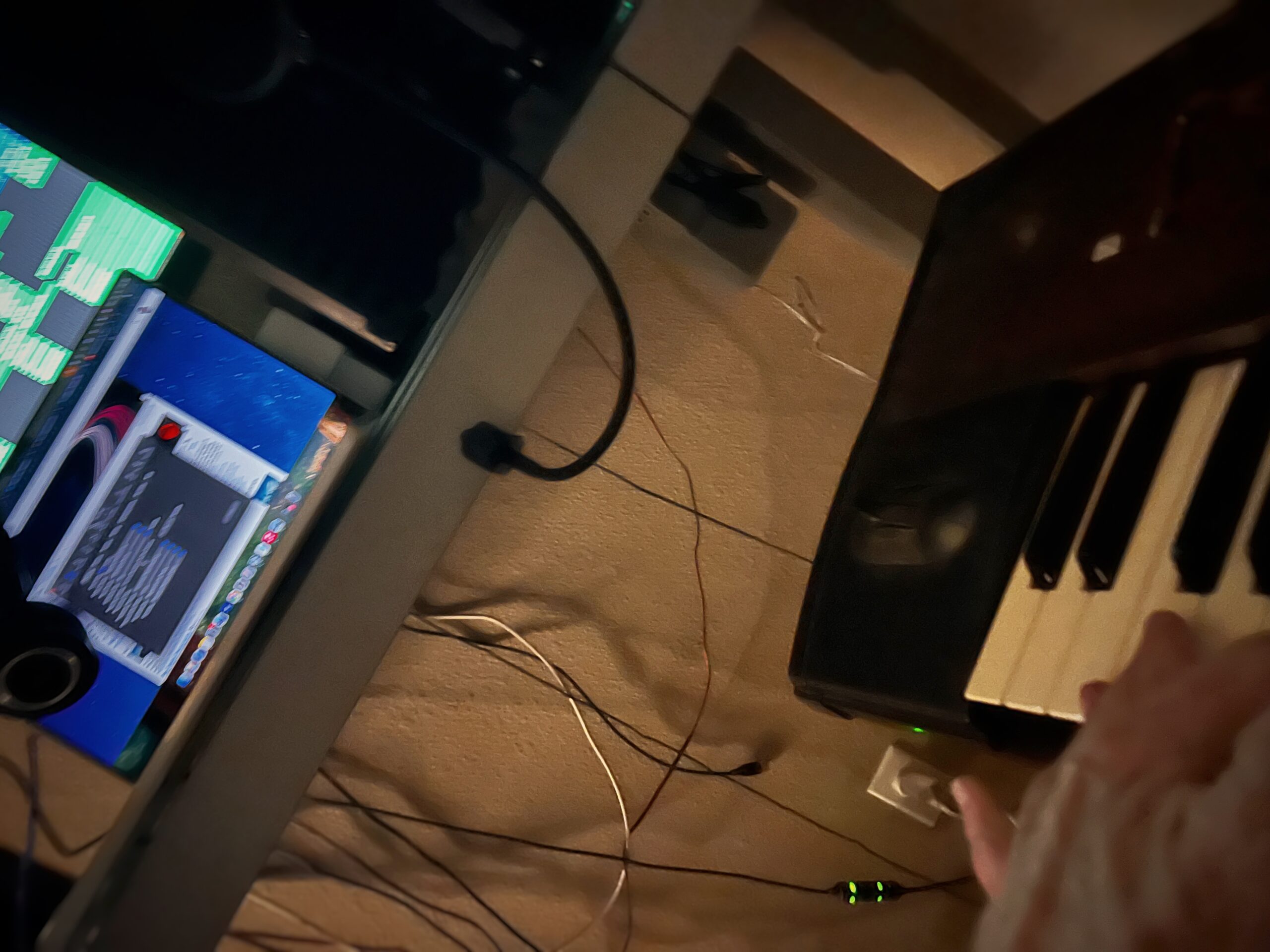
People ask me a version of the same question all the time:
“With everything you’ve got going on… why are you still doing music?”
Translated: “You’re slammed. You’re not touring arenas. Why are you still burning nights in the studio?”
Here’s the honest answer: some folks go to therapy. I go to the studio.
Music is how I stay functional, connected, and sane. The money would be nice, but if I ever made that the main reason, I’d probably stop making anything worth listening to.
The Studio As My Therapy Couch
I’ve learned something about myself: if I go too long without writing, playing, or producing, I start to wither.
Music is my pressure valve. It keeps me from going quietly insane under the weight of everything else I’m juggling. When I’m in the room with a synth, a half-finished drum pattern, and a blank project file, the rest of the noise drops about ten levels.
It’s my sanctuary.
It’s the one place I can tell the truth without editing.
In songs, I can investigate feelings I don’t always have language for. I can admit where I’ve been wrong, make my own little confessions, and celebrate the messy, human side I don’t always show in a meeting or a Zoom call. I don’t have to be polished. I just have to be honest and keep showing up.
Getting Better, Even When I Hit The Wall
I also just love the craft.
Right now, I’m obsessing over widening the mix, giving tracks more breathing room, and making them more ethereal and atmospheric. That probably sounds geeky, and it is. I’ll get stuck on a plateau where nothing sounds right, and every instinct says, “Throw the keyboard and Mac out the window.”
But every time I push through one of those phases, my productions level up.
The kick sits better. The vocal sits in the pocket instead of on top of the track. The whole thing feels more like what I hear in my head when I start.
Even when I’m frustrated, that process of “slightly better than last year” is addictive. Mixing, mastering, producing, writing, programming, sequencing, playing – they all demand discipline. And that discipline spills over into everything else I do.
My Lab For Ideas I’d Never Try On Clients
Sunset Sky is also my lab.
There are sounds and structures and weird choices I’d never test first on a client’s release. That’s not fair to them. But on my own tracks? I can go left. I can try the strange bridge, the broken groove, the super sparse arrangement, the ultra-dry vocal, the reverb-soaked everything.
I get to see how audiences respond to something that’s not designed to be a guaranteed moneymaker. I get to learn what connects when you don’t have a huge promo budget, a label, or a big machine behind you.
So when I’m working with clients, their ROI feels easier by comparison. I’ve already watched what happens when you’re trying to get streams, saves, and shares out of something that is basically art on hard mode. Helping a brand or an artist hit their numbers is still work, but it doesn’t feel impossible.
The Gift Of Not Needing It To Pay The Bills
A wise friend, Darin Herleikson, said something to me when I was wrapped around the axle trying to monetize everything:
“Sometimes it’s best to look at your passion as a hobby.”
He was right.
The second I stopped demanding that every track earn its keep, the whole process opened up. I can’t imagine the pressure that full-time music business folks feel, where every release has to be profitable. Respect to them. That’s a heavy lift.
For me, treating music like a serious hobby – not a side hustle that has to justify itself on a spreadsheet – made it fun again. It made me braver creatively. It made me more willing to miss, because my survival doesn’t depend on the hit.
Instead, the question becomes:
Does this song mean something?
Did it land with even one person who needed to hear it?
That’s the payoff. Not the royalty statement.
Finding Time When There Is No Time
So how do I find the time with everything else going on?
I don’t. There isn’t time. I have to steal it.
I prioritize music the same way I should be prioritizing exercise (and yes, that needs to be stepped back up). If I don’t block time for it, it disappears under meetings, emails, campaigns, and deadlines. And when it disappears, I start running on fumes.
Music is as important to me as movement. If I ignore it long enough, my mental health, creativity, and patience all start to drop.
So I carve out late nights, early mornings, and odd pockets of time because I know what happens if I don’t. I’m not more “available” to the rest of my life when I skip music. I’m actually less present, more reactive, and more burned out.
In the end, it makes me better at everything else I do.
Why I’ll Keep Doing This
Sunset Sky probably won’t be headlining stadiums. I’m okay with that.
I make music because I have to. Because it keeps me sane. Because it lets me be honest. Because each year, the work gets a little sharper, a little more dialed-in, a little closer to whatever sound I’m chasing in my head.
I make music because it’s my sanctuary in a loud, fast life.
Because when someone messages me and says, “Hey, that track helped me through a rough week,” that’s enough.
If the money comes someday, great. If not, I’ll still be in the studio, chasing wider mixes, more breathing room, and the next song that tells the truth a little better than the last one.